When a perfect image has nothing to say
On AI, aesthetics and the strange feeling that something can be missing from an image despite its beauty.
The beauty of the expected
We live in a time when it has become remarkably easy to create impressive images.
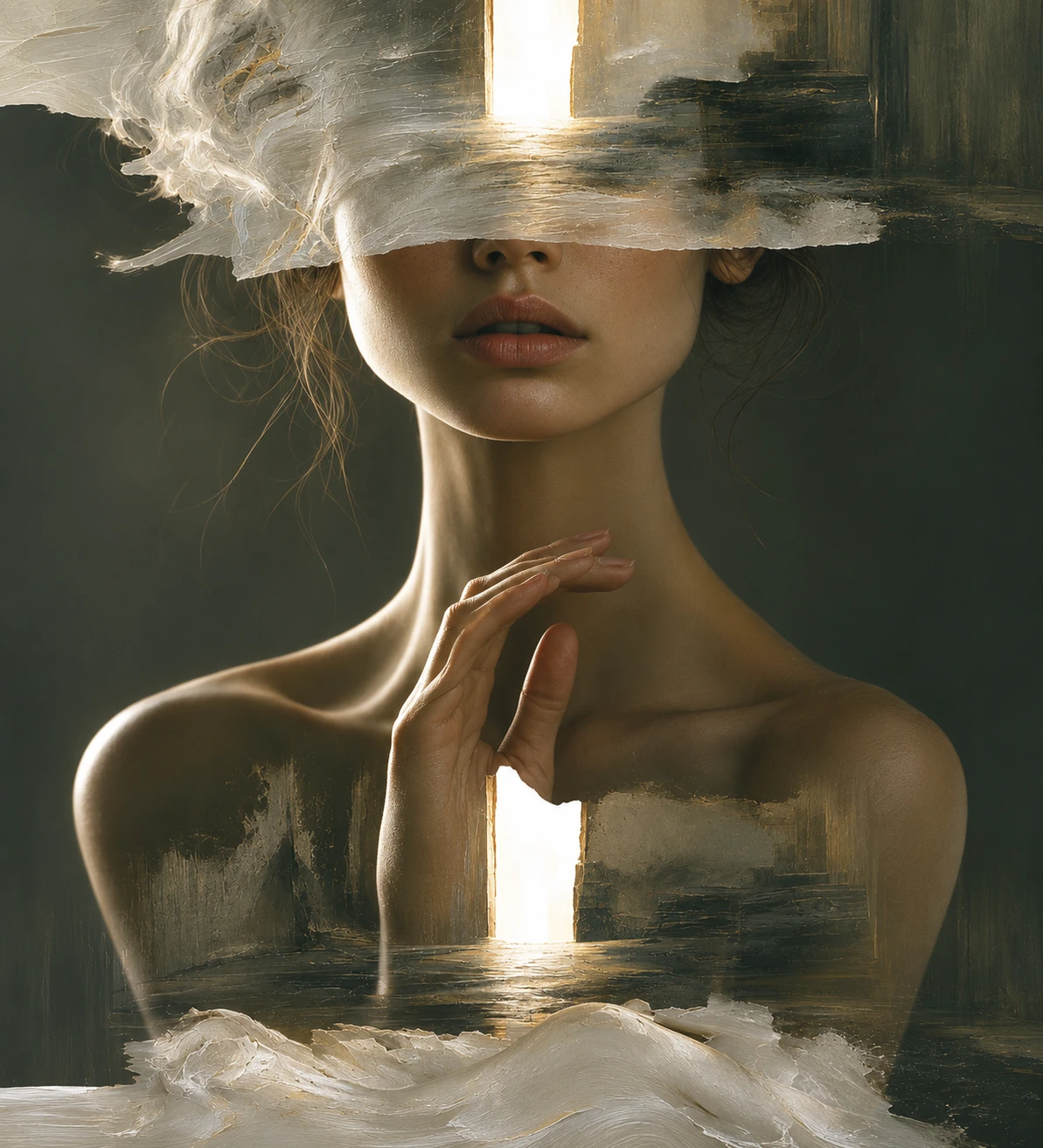
Perfect light. Perfect skin. A composition that seems to leave nothing to be desired.
And yet I keep finding myself looking at such an image and moving on after a few seconds.
Why?
Perhaps because perfection does not necessarily have anything to do with meaning.
An image can be visually compelling without raising a question. It can get everything right and still risk nothing.
I encounter this phenomenon often, especially when working with generative AI.
The technology can do an extraordinary amount. It reproduces and combines countless aesthetic patterns, often producing remarkably convincing results.
But beauty alone does not always interest me.
Sometimes the most compelling moment arrives only when I begin to work against the result.
When I shift a shape. Remove a part. Put something familiar into a state that can no longer be clearly identified.
Suddenly a tension appears that was not there before.
The moment when something is missing
I do not believe that art must always unsettle us.
Silence can be powerful, too. Harmony can move us. Beauty can have a depth of its own.
But I ask myself why some images stay in our memory while others disappear, even when they are technically almost perfect.
Perhaps it is because we are not only looking for images that please us.
Perhaps we are looking for something that meets us in a way we do not yet fully understand.
An image does not have to explain everything.
Sometimes its greatest strength is that it leaves something open.
What remains when the effect fades?
The technical possibilities of generative AI will continue to evolve. What impresses us today may feel ordinary tomorrow.
That is why I do not want to define my artistic work solely by technical quality.
I am interested in which ideas will endure even when the technology used has long become commonplace.
Which images would we look at a second time?
Which would occupy our thoughts if we did not know how they came into being?
And which might we not miss at all?
Perhaps the true quality of an image only becomes visible after its first impression has passed.